Google’s AI Mode Has Arrived – What Now?

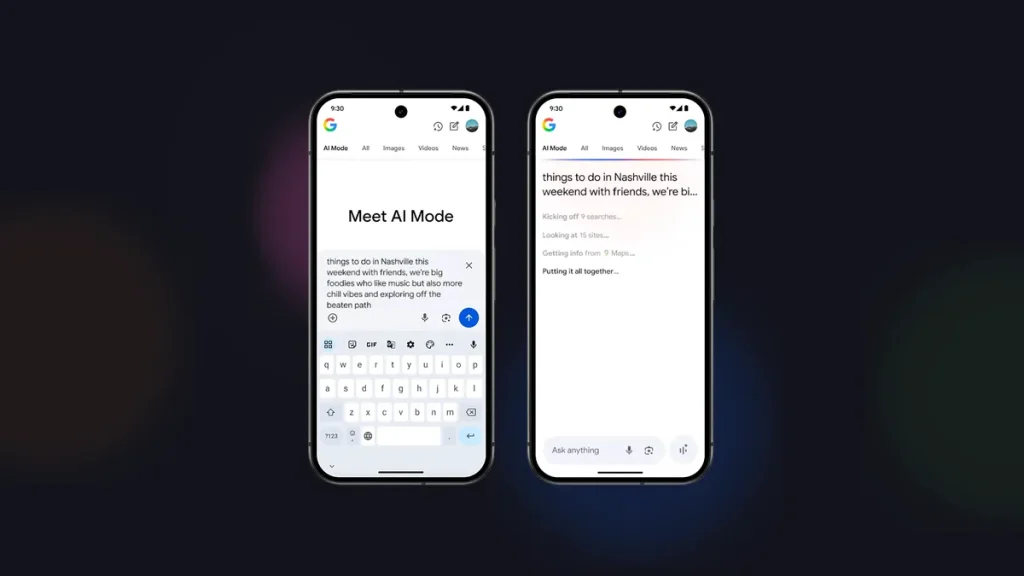
- AI Mode launched in Canada in August and the U.S. in June, and early queries run 2 to 3 times longer than traditional Google searches, signaling a shift toward exploratory, multi step questions.
- Ads inside AI Mode are still U.S. only, but advertisers can prepare now by running Broad Match, Shopping, Performance Max, or AI Max for Search, the campaign types eligible to appear as the format expands.
- Shopping ads already capture about 85% of all Google Ads clicks globally, and Performance Max campaigns are hitting 95% to 116% of target ROAS, underscoring how much weight feed based and AI powered campaigns now carry.
- U.S. spending on AI driven search ads is projected to grow from roughly $1 billion in 2025 to nearly $26 billion by 2029.
- Service providers should audit Google Business Profile, Local Services Ads, and landing pages now, since AI Mode pulls real time business details and incomplete listings mean missed visibility.
Google Search is in the middle of its most significant transformation in years. With the launch of AI Mode in Canada in August and the US in June, consumers are no longer just typing in short keywords. They’re asking Google complex, open-ended questions and receiving detailed, conversational answers powered by generative AI.
What is AI Mode?
AI Mode builds on Google’s AI Overviews, layering in smarter analysis, cross-media search, and real-time insights from the web, Google’s Knowledge Graph, and billions of shopping data points.
Unlike traditional search, AI Mode issues multiple related queries simultaneously, fanning out across subtopics before displaying the results into a single, easy-to-understand answer.
Key Takeaway: people are using AI Mode to explore bigger, more complicated questions. Early tests show that queries are 2-3x longer than traditional Google searches and this is signaling a shift in how consumers express intent.
Ads Are Coming to AI Mode
The good news: businesses will be able to reach these new AI-powered search users.
Google is already testing ads directly within AI mode, where they appear alongside the AI-generated answer. This means ads are matched not just to the original query, but also to the broader context of the conversation – opening up richer targeting opportunities.
To get ads serving in AI Mode, advertisers need to be leveraging Google’s AI-powered targeting solutions. These include:
- Broad Match keyword targeting
- Shopping campaigns (via Merchant Center feeds)
- Performance Max (PMax) campaigns
- AI Max for Search (beta)
And the opportunity is significant:
- Shopping ads already capture 85% of all Google Ads clicks globally, showing how important feed-based (campaigns that rely on a product or service data feed) campaigns will be in AI Mode.
- Performance Max campaigns are showing stronger ROI, with Return on Ad Spend (ROAS) targets rising from 4.7x to 6.0x, and most campaigns achieving a 95-116% of target ROAS.
- U.S. spending on AI-driven search ads is projected to surge from just over $1 billion in 2025 to nearly $26 billion by 2029. This is a strong signal of where the Canadian market is heading.
Key Takeaway: AI Mode is already live in Canada, giving users access to conversational search. Ads in AI mode, however, are still limited to the U.S. With Canadian availability expected soon, advertisers should ensure they are running one of the above campaign types now so they’re eligible to appear as soon as AI Mode ads expand.
How Consumers Are Using AI Mode
Early usage shows that people lean on AI Mode for more than simple facts. They’re turning to it for exploratory and multi-steps tasks.
Examples include:
- “What’s the best way to start a business with limited resources?”
- “Plan a 7-day trip through Italy with family-friendly stops.”
- “Compare eco-friendly home heating options under $5,000.”
This reflects a major shift: search is becoming less about finding one quick answer and more about navigating an entire decision journey. For advertisers, that means opportunities to connect with customers earlier in the funnel, during research and consideration.
Supporting this trend, Google reports that 1 in 5 Google Lens (visual) searches already show commercial intent. Combined with longer, conversational queries, this shows how multi-format search behaviors are converging to create new entry points for brands.
Service Providers: Accuracy Builds Trust
For consumer services, accuracy in how you present your business is critical. AI Mode pulls from real-time business information such as your service areas, hours, pricing, and reviews to shape both ads and AI-generated answers. If your information is incomplete, inconsistent, or outdated, you risk not showing up when potential customers are comparing providers.
Why It Matters: Longer, intent-rich queries now make up over 90% of searches, and these highly specific service-related searches often convert at 2× the rate of basic keywords. That makes having clear, accurate details like service descriptions and coverage areas to contact info and availability more important than ever.
Key Takeaway: Service providers should audit their online listings (Google Business Profile, Local Services Ads, and landing pages) to ensure information is accurate, complete, and consistently refreshed.
Why It Matters
AI Mode is a fundamental shift in how people search and also how businesses are discovered:
- People are asking longer questions: Searches in AI Mode are already 2-3x longer than before, which means users are coming in with clear, detailed intent.
- Ads are where the clicks happen: Shopping ads capture about 85% of all Google Ads clicks worldwide, showing just how powerful they are.
- Proven ROI: Performance Max campaigns are consistently hitting 95–116% of their target ROAS.
- The market is growing: AI-driven search ad spend is expected to grow from $1B in 2025 to $26B by 2029, showcasing a 25x jump.
- The AI advantage: Companies leaning into AI are seeing 60% faster revenue growth and are keeping up with consumer trends twice as quickly as their competitors.
Advertisers who embrace AI-powered campaigns, feed hygiene, and intent-driven strategies today will be best positioned to capture demand tomorrow.
Closing Guidance
Search isn’t just about keywords anymore. It’s about real conversations, deeper exploration, and understanding intent. With AI Mode rolling out, brands have a key opportunity to rethink how they connect with customers at every stage of the journey.
What advertisers should do now:
- Check your campaigns: Make sure you’re using Broad Match, Performance Max, or Shopping campaigns so your ads are eligible to appear in AI Mode.
- Keep your product feed clean: For retailers, accuracy matters. Double-check that your pricing, availability, and product details are always up to date.
- Connect paid and organic strategies: Build useful, multi-format content that can surface in both AI answers and your ads.
- Pay attention to signals: Look for changes in query length, new long-tail searches, and campaign performance as early signs of AI Mode influence.
- Be ready to adapt: Reporting won’t break out AI Mode right away (similar to PMax). The brands that win will be the ones testing, learning, and adjusting ahead of the curve.
The bottom line: AI Mode is changing the rules of search, and the brands that embrace AI-driven discovery now will be the ones best positioned to capture consumer intent in 2025 and beyond.
If you are wondering how to navigate these changes for your organization – we’re here to help.
Sources: Think With Google, eMarketer, Smarter-eCommerce, DemandSage, ROI Revolution, Link-Assistant, Backlinko
Frequently Asked Questions
Reporting is built into the Spark™ cycle deliverables when the Other. Performance media team is running the program. In the case of working with in-house teams we can handle reporting or your in-house team can work within our reporting framework.
Spark™ was built for performance environments. Our team blends design, copywriting, and media insight to create, test, and refine ads that deliver measurable results - not just impressions.
AI supports our creative team with concept generation, asset variation, and production efficiency, allowing us to move faster without sacrificing craft or quality.
Spark™ runs in structured cycles aligned to ad spend and marketing priorities. Each cycle produces new creative, tests variants, and scales what performs best - improving results with every round.
Spark™ is built for marketers running performance media across channels like Meta, Performance Max, DemandGen, YouTube, TikTok, Pinterest and more who need creative that can keep up with rapid demands of the platforms.

Jordan Yates is Director, Search Marketing at Other.™, where they oversee the search practice. Jordan makes sure the team stays ahead of advancements in search, from AI-driven tools and evolving strategies to the shift toward first-party data.
This keeps the team's approach current as the platforms and privacy landscape continue to change, translating those shifts into search strategies that still deliver for clients.








Let’s raise the bar together.