Hit a performance plateau? Start solving it with this proven framework.


- Other.™'s four pillar framework for a performance plateau covers spend, efficiency, media mix, and creative engagement, worked through calmly and in that order.
- Start with spend: model whether your budget is sufficient to hit the target before assuming the problem is optimization, then check sufficiency by market and by channel.
- Move to efficiency: audit every channel against its intended KPI, reallocate to what is working on a set timeline, typically three weeks in digital and about four in traditional media, and feed first party data back into the algorithm.
- Reassess media mix by evaluating where your audience actually is, and set aside roughly 5% to 10% of budget to test new channels with the explicit goal of learning, not immediate performance.
- Audit creative consistency and engagement across channels, benchmark it against historical data, and build a continuous testing framework so the next plateau does not repeat this one.
Don’t panic, just move your team calmly but expediently to get it solved.
The journey of a CMO or VP of Marketing in a performance-focused organization is fraught with challenges these days, none more daunting than the dreaded performance plateau. This is the moment when, despite your best efforts, growth stalls, and results seem to flatline. It’s a scenario I’ve seen many marketers grapple with, and it often marks a critical point where the need for strategic reassessment becomes important. The key is to not panic and to move through a series of growth vectors (or barriers) calmly, but quickly.
The Reality of Performance Plateaus, They Suck.
A performance plateau is more than just a temporary hiccup; it’s a clear indicator that the strategies which once drove success are no longer as effective. Whether it’s generating leads, revenue, or driving to bricks and mortar – hitting this plateau can feel like running into an invisible barrier. Alongside that barrier is the organization staring you in the face and asking for results. Recognizing this plateau is the first step toward overcoming it.
Start with a Framework.
At Other. we use a specific four-pillar framework to help our clients identify what is holding them back and to work with them to overcome their plateau. Here is the framework we use:
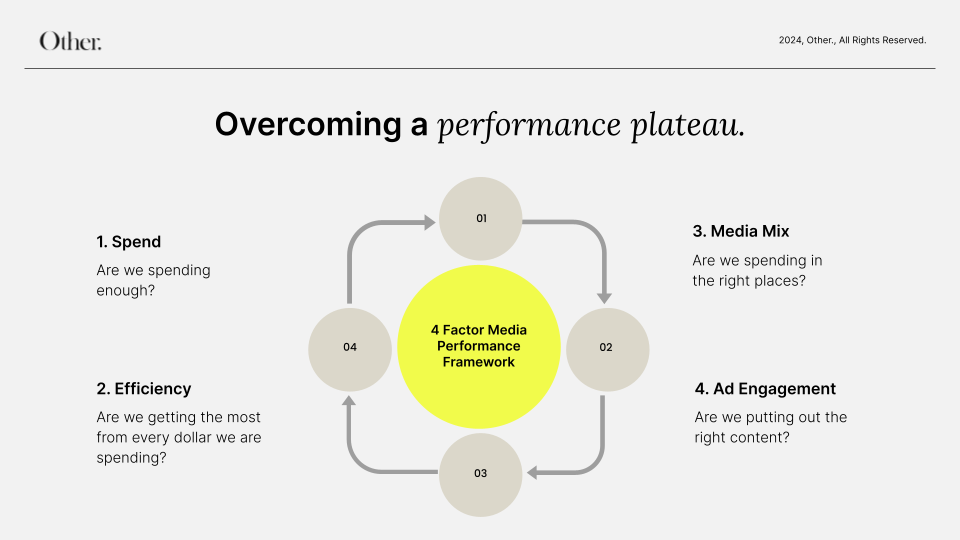
Spend: Sometimes, the barrier to growth is not how you spend but how much. Reassessing your budget against your objectives can reveal if you’re truly investing enough to achieve your growth targets.
Efficiency: The question isn’t just about spending money but about spending it wisely. By assessing the return on investment across your campaigns and channels, you can identify areas of waste and reallocate resources to more productive avenues.
Media Mix: In today’s fragmented media landscape, sticking to a single channel or an outdated mix can severely limit your reach and impact. It’s crucial to diversify your efforts to match where your audience is most engaged and to test new channels that can unlock growth.
Creative Engagement: Efficiency in spending and choice of media means little if your efforts don’t convert at the desired rate or drive the engagement needed to build consideration. Analyzing your creative for inefficiencies can unlock significant improvements in overall performance.

Digging in: The 4 key areas where you can drive impactful change:
1. Spend
Question to answer: Are we spending enough?
Key areas to investigate and actions to take:
- Budget Forecast to Impact: At the highest level you need to work back if your budget is sufficient to hit your target. Take your current unit economics and marketing metrics and model this out with some informed assumptions (we will provide guidance here in future articles). Sometimes we see marketers get wrapped up in the day-to-day and forget that the budget they are investing in paid is just insufficient to hit their target – regardless of optimization – and that they need to make gains in other areas.
- Budget by Market: If your budget looks sufficient with some performance improvements baked in but is broken out on a market-by-market basis (see the risks of this with AI in this article), then you need to assess whether your budget is sufficient in each market. If it’s not, you will likely need to make market sacrifices to get over the plateau overall.
- Budget by Channel: The last area to investigate is if your budget by channel is sufficient. Underinvesting in a specific channel can be counterproductive if you are not hitting the minimum spend required to make an impact. This can be seen in both traditional media and digital media, it’s where your budget is just spread too thin. Remember, you should have identified if you are over-invested by assessing efficiency above. If you are underinvested, go back to the unit economics of your best-performing channels and look at the needs of the business – then make a decision.
2. Efficiency
Question to answer: Are we getting the most from every dollar we are spending?
Key areas to investigate and actions to take:
- Perform an audit and analysis: Conduct a comprehensive review of all marketing channels to pinpoint where investments are not yielding sufficient returns based on your objective. This step is crucial for identifying and eliminating inefficiencies. In many cases some channels are just not delivering against their intended KPI targets and if you’ve hit a plateau you need to get rid of waste here.
- Allocate resources to what’s working – but set a timeline for intended impact: Redirect funds and your team or agency focus toward high-performing channels. Set a clear timeline or spend threshold to help you and your team understand if the pivots you have made are working as intended. Depending on spend thresholds you can typically get an understanding within 3 weeks (or sooner) in digital media and about 4 weeks from launch in traditional media, in our experience.
- Leverage technology to get more out of your dollars and resources: Understand how you can get more out of every dollar by using technology to improve optimization or insight. Technology typically reduces time spent by a team and the time to surface insights and opportunities so that a team can then move quickly to optimize.
- Use your 1P Data to improve quality signals: Though typically a heavier lift, data utilization may be the key to breaking through a performance plateau. This is because (especially in the case of digital media) the signals you feed back to the algorithm can have a material impact on the quality of consumer you are bringing in, which then has a strong downstream impact on conversion.
3. Media Mix
Question to answer: Are we spending in the right places?
Key areas to investigate and actions to take:
- Channel evaluation: Take a good look at your channel mix. Are you investing where your audience is? Are there areas you can invest in that are less competitive and offer similar audience sizes with better unit economics? Channel mix is just as much about where you are as where you aren’t.
- Strategic & tactical evaluation: Within each of your channels, what are your key strategies and tactical mix? If you’ve hit a performance plateau your strategies or tactics might not be working effectively or have hit a point of diminishing returns – so it’s time to change it up.
- Channel experimentation: Once you’ve optimized your current channels, you may need to expand to continue to be able to drive growth. Though sometimes difficult, it’s important to test new channels and content formats to uncover untapped opportunities for engagement and growth. Set a percentage of your budget (we see anywhere from 5-10%) for testing. This means that the sole purpose of opening this channel is to understand if it will be successful or not. It’s critical to communicate to your team that it’s ok to fail here – that’s the point.
4. Ad Engagement
Question to answer: Are we putting out the right content and at the right time?
Key areas to investigate and actions to take:
- Ensure there is integrated communication: List the channels you have on a whiteboard or digital whiteboard like Miro and create sections for each channel. From there, paste examples of your creative across each channel. Is there consistency in your primary marketing message? Brand assets? Tonality? Start here to assess if what is in marketing is working together.
- Assess ad creative by channel: Go get benchmarks. Ask your agency, look at historical data, or use a service like Insider Intelligence. Next, zoom in on each channel by pulling performance metrics for digital ads across channels and if you are doing traditional, any available market research you have. Layer that data in a sticky note over each ad and compare against the benchmark – how is the ad doing? This will help you to understand if it’s poor ad engagement that could be holding you back. It can certainly be more complicated than this based on funnel-stage or channel, but try to keep it simple at the start.
- Improve creative engagement through testing: Use your best performing creative as a starting point and begin structuring a testing framework so that you don’t hit a plateau and are constantly developing your next ad variations. This is of course more difficult than it sounds, but is worth the time and resources as creative becomes even more essential (especially in digital media).
You’ve done it! Or maybe you haven’t, but it’s still a win.
Overcoming a performance plateau demands a strategic reassessment of your current marketing approach. By focusing on efficiency, diversifying your media mix, strategically allocating your budget, and optimizing for engagement and conversion, you can get through that performance plateau.
Here’s the thing though, it won’t always work. Sometimes market conditions are stacked against you in a way that is just not possible to overcome. The most important element here then is that even if this is true, you have optimized your performance program and media in such a way that you should now be unlocking significantly more from your budget.
We hope this was valuable to you, and if you are ever looking for benchmarking or a confidential second set of eyes, reach out to us here at Other.
Frequently Asked Questions
Reporting is built into the Spark™ cycle deliverables when the Other. Performance media team is running the program. In the case of working with in-house teams we can handle reporting or your in-house team can work within our reporting framework.
Spark™ was built for performance environments. Our team blends design, copywriting, and media insight to create, test, and refine ads that deliver measurable results - not just impressions.
AI supports our creative team with concept generation, asset variation, and production efficiency, allowing us to move faster without sacrificing craft or quality.
Spark™ runs in structured cycles aligned to ad spend and marketing priorities. Each cycle produces new creative, tests variants, and scales what performs best - improving results with every round.
Spark™ is built for marketers running performance media across channels like Meta, Performance Max, DemandGen, YouTube, TikTok, Pinterest and more who need creative that can keep up with rapid demands of the platforms.

Deryck Marriott is VP, Performance Media at Other.™, where he oversees the entire performance media practice. He leads specialized teams across programmatic, search, and social, each built around deep platform expertise.
Deryck makes sure the agency stays on the cutting edge of platform advancement and changes and that his team work diligently to deliver real business returns for clients.







Let’s raise the bar together.